
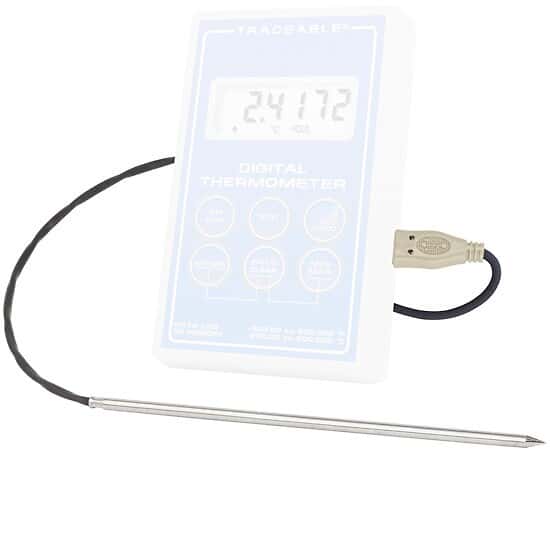
Includes
Traceable® Certificate.
Key Features
- Designed with USB connection
- Probe temperature measuring range is from –100 to 200°C (–148 to 392°F)
- 10-ft long PTFE cable
- Includes NIST-traceable certificate from our A2LA accredited (1750.01) calibration laboratory
- 1 year warranty
More About This Item
Available with or without handle, these Traceable® RTD probes are designed to be used with scientific RTD thermometer 37804-06.
Traceable® Products come with an individually numbered Traceable® Certificate provided with each unit, assuring accuracy from our ISO/IEC 17025:2017 (1750.01) calibration laboratory, accredited by A2LA. The certificate indicates traceability of measurements to the SI units through NIST or other recognized national measurement institutes (NMIs) that are signatories to the CIPM Mutual Recognition Agreement. Every Traceable® product undergoes an intense vetting process before it can carry the Traceable name, saving you both time and money by eliminating the need for separate calibration.
For improved performance, probes should be calibrated as a system with the meter.
Guaranteed to have at least one year of calibration remaining on certificate.

TC –
Works Great with either 31804-06 or -07
This is the probe that came standard with 31804-07, but that system has been discontinued and the new model called 31804-06 comes with a different probe, that is now available on it’s own as 31804-08. In reality, the two meters are identical so you can use either probe with either meter. Just realize that you should have the system recalibrated if you change the probe. You can’t rely on a probe and a meter that were calibrated separately unless you just want it to be “close”. The reason to buy this probe (-09) is heat resistance. The wires and their wrapper are both heat and chemical resistant. We can put them inside a 180C oven as long as necessary and there is no deterioration. The -08 version that comes with the -06 meter has a plastic handle that is designed to stay outside of the material or environment you are measuring. If you have a furnace that has a pinhole sized for the metal part of the probe, the -08 probe should work, But if the whole handle has to be inside the oven, it will melt at about 120C. In fact it gets pretty soft at 104 C. The only downside I have found to the design of the -09 probe (the one I am reviewing) is that if you fully immerse it in a liquid, it is possible for some of the liquid to enter the metal body of the probe where the wires enter it. It’s pretty easy to seal this opening. We cover it with tape and parafilm if there’s a chance it will fall into the water bath it is being used to test. We could probably use a more permanent material but we don’t want to risk the high temperature performance. That is what makes this probe so valuable to us.